

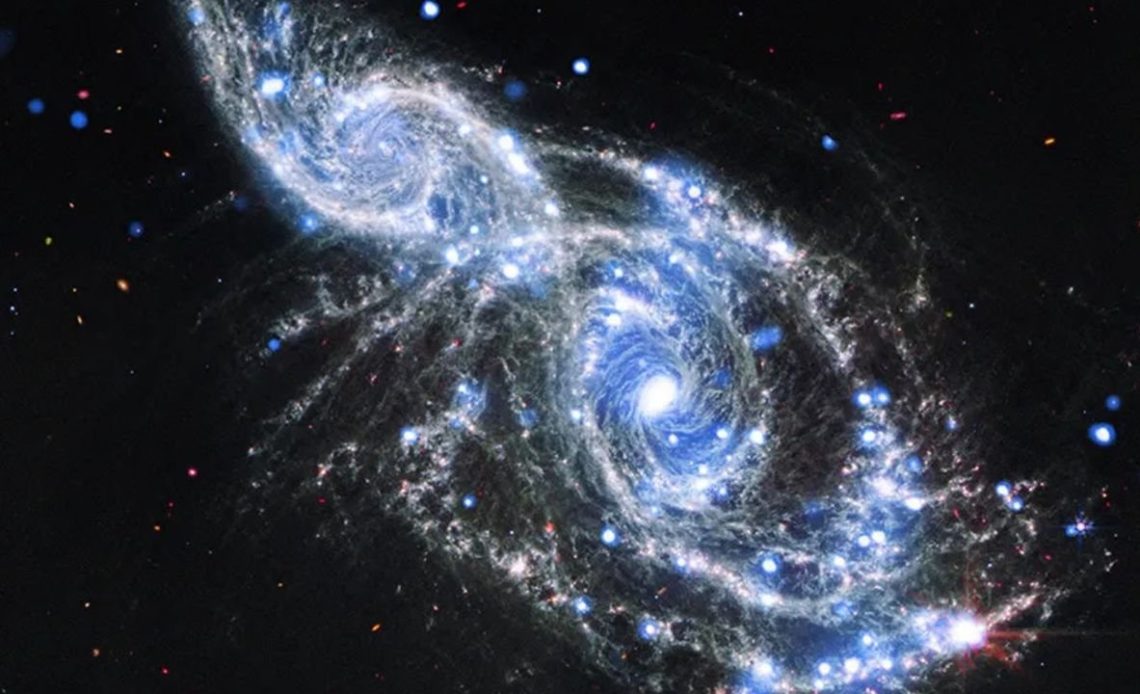
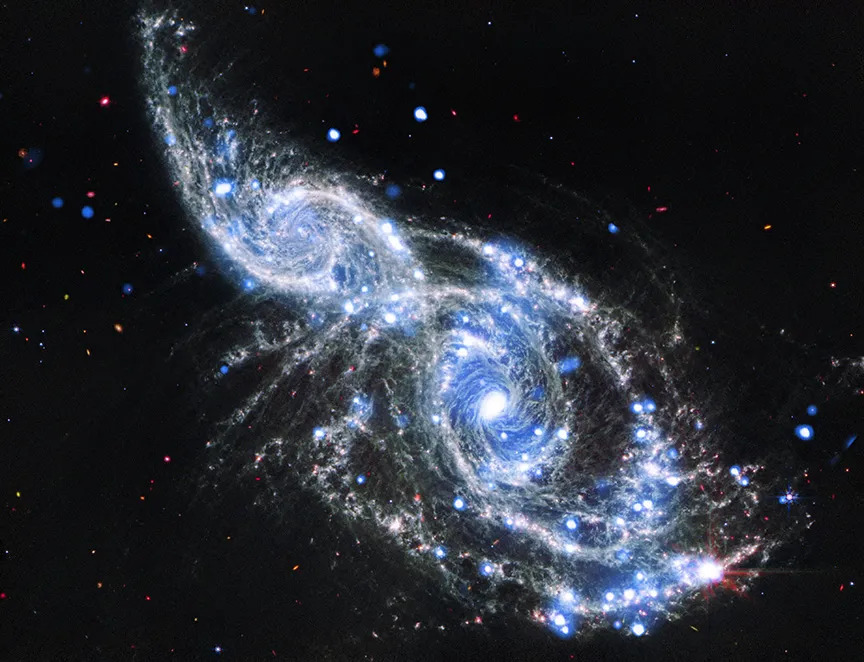
Recently, two NASA space telescopes, the James Webb Space Telescope and Chandra X-Ray Observatory, captured images of two galaxies beginning to collide. NASA released a composite image showing both the visible and X-ray spectra of the collision. The smaller galaxy, IC 2163, is at the upper left, while NGC 2207 dominates the center and lower right. Their long, silvery-blue spiral arms are peppered with bright knots and specks, the telltale signposts of active, messy astrophysics in progress.
These galaxies grazed each other millions of years ago, in a gravitational close pass that bent and stretched their spiral structures. And, billions of years from now, the pair is expected to merge into a single galaxy.
What is it?
The two telescopes that caught this galactic hug look study space using different wavelengths. Webb is designed to observe primarily infrared light, which is especially good at revealing dust, cool-to-warm gas, and star formation regions that can be hidden in visible-light images. To do that work, Webb operates far from Earth in a sun-orbiting path near the Sun–Earth L2 point, about 1 million miles (1.5 million kilometers) away from us — an arrangement that helps keep the observatory stable and cold.
Chandra, by contrast, is built to observe the X-ray universe, studying light produced in places where matter is heated to millions of degrees, shaped by extreme gravity, magnetic fields, and explosive events. Because Earth’s atmosphere blocks X-rays, Chandra operates in space in a highly elliptical Earth orbit, enabling long, uninterrupted observations above our planet’s radiation belts.
And when you combine the two telescopes, you don’t just get a prettier picture, you get a more complete physical map of what’s happening in and between galaxies.
Where is it?
The two galaxies, IC 2163 and NGC 2207, are estimated to be around 120 million light years away in the constellation Canis Major.
Why is it amazing?
Collisions and mergers are two of the main ways that galaxies grow and change over cosmic time. Seeing a colliding pair face-on is especially valuable: it lets astronomers trace how spiral arms warp, where material gets compressed, and how the interaction redistributes gas and dust that can later form new stars.
The image’s framing — a near-miss in the past, a merger in the far future — highlights that galactic mergers unfold over enormous timescales, and images like this capture a crucial middle phase: after the first close pass, when gravity has already reshaped both galaxies, but before the final coalescence into one.
Want to learn more?
You can learn more about galaxy formation and space telescopes.
Author: Kenna Hughes-Castleberry
Source: Space.com
Reviewed By: Editorial Team