

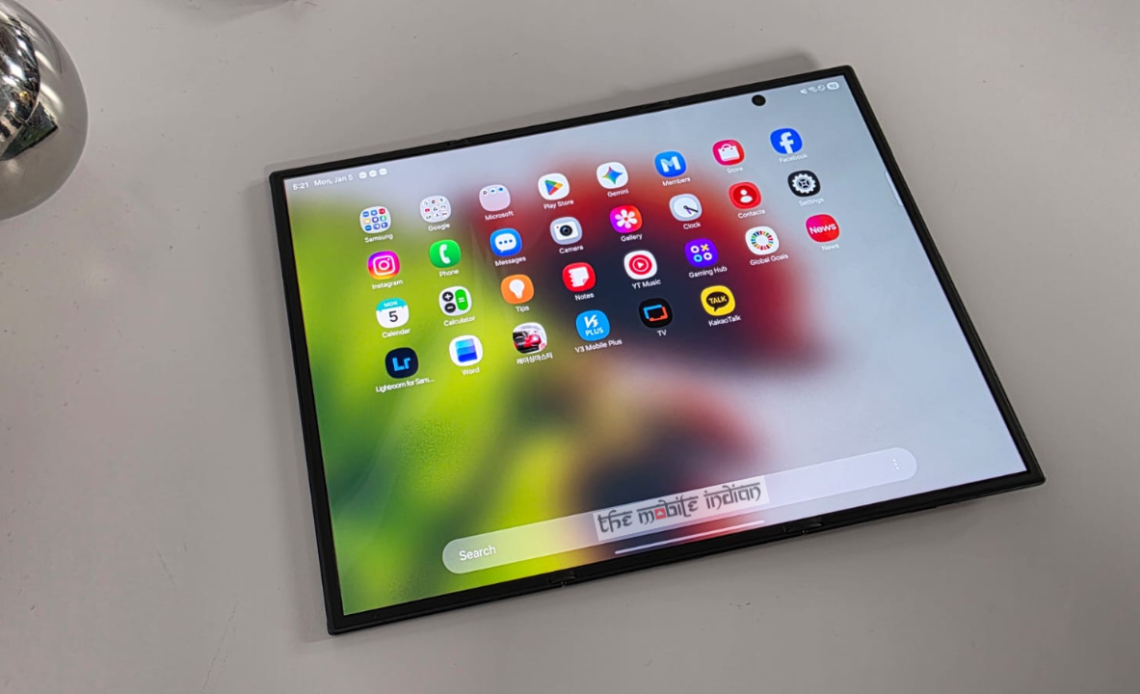
Samsung is restricting the rollout of its Galaxy Z TriFold smartphone to a few select markets, excluding India for now, as it weighs demand, manufacturing volumes and return on investment for ultra-premium devices.
JB Park, President and Chief Executive Officer of Samsung Southwest Asia, told a select group of journalists at the Wynn Hotel in Vegas at CES that the company is currently selling the TriFold in only a handful of markets and is proceeding cautiously before expanding availability. “There are only two countries that sell the TriFold currently, and we just added Dubai and Singapore as the third and fourth,” Park said. “We are not selling globally, even in Europe or in South American countries. It’s not available anywhere except Korea and U.S. market, which are the dominant markets, and some to Dubai and Singapore.”
Samsung’s TriFold device, which represents a new form factor beyond conventional foldable smartphones, has attracted attention for its design and positioning at the top end of the premium segment. However, Park said market selection for such devices depends on timing, scale and manufacturing viability rather than geography alone.
“But when is the right time to bring in a technology?” Park said. “This is not limited to TriFold, but any devices that is premium like our XR where we collaborated with Google.”
Park said Samsung evaluates whether demand in a given market can justify the minimum production volumes required to make local manufacturing viable. He pointed to minimum order quantities (MOQ) as a key constraint.
“When are we bringing those devices, and how much quantity does it justify for us to run the manufacturing?” he said. “I think the MOQ, I would say is half a million units for me to really get the ROI out of it.”
Related Story:
Bengaluru Research Centre Matches Silicon Valley in AI Contribution: JB Park, Samsung
India has emerged as one of Samsung’s largest markets by volume, driven largely by mid-range and mass-market smartphones. However, Park indicated that selling ultra-premium devices such as the TriFold at scale remains a challenge.
“Can I sell half a million units of TriFold in India?” he said. “That is a task that I have to solve.”
Samsung manufactures a significant portion of its smartphones in India, where it operates one of its largest production facilities globally. Asked directly whether the TriFold would be launched in India in the near term, Park ruled out any immediate plans.
“At this moment, no,” he said. Samsung’s cautious approach for TriFold is a bit different from its broader push in India across other categories, including smartphones, consumer electronics and software development. The company has expanded its research and development footprint in the country and continues to position India as a strategic market for long-term growth.
However, the TriFold decision highlights the limits of that strategy when it comes to experimental or ultra-premium hardware. While Indian consumers have shown willingness to adopt high-end smartphones, volumes in the topmost price brackets remain relatively small compared with markets such as the United States and South Korea.
Park’s comments also suggest that Samsung is applying similar criteria to other emerging technologies, including extended reality devices developed in partnership with Google. Such products, he said, would follow the same logic of demand validation and manufacturing scale before being introduced in India.
For now, Samsung appears focused on rolling out its most advanced form factors in select markets, while assessing whether India can support the volumes required to make local production commercially viable.
Author: Sandeep Budki
Source: The Mobile Indian
Reviewed By: Editorial Team