

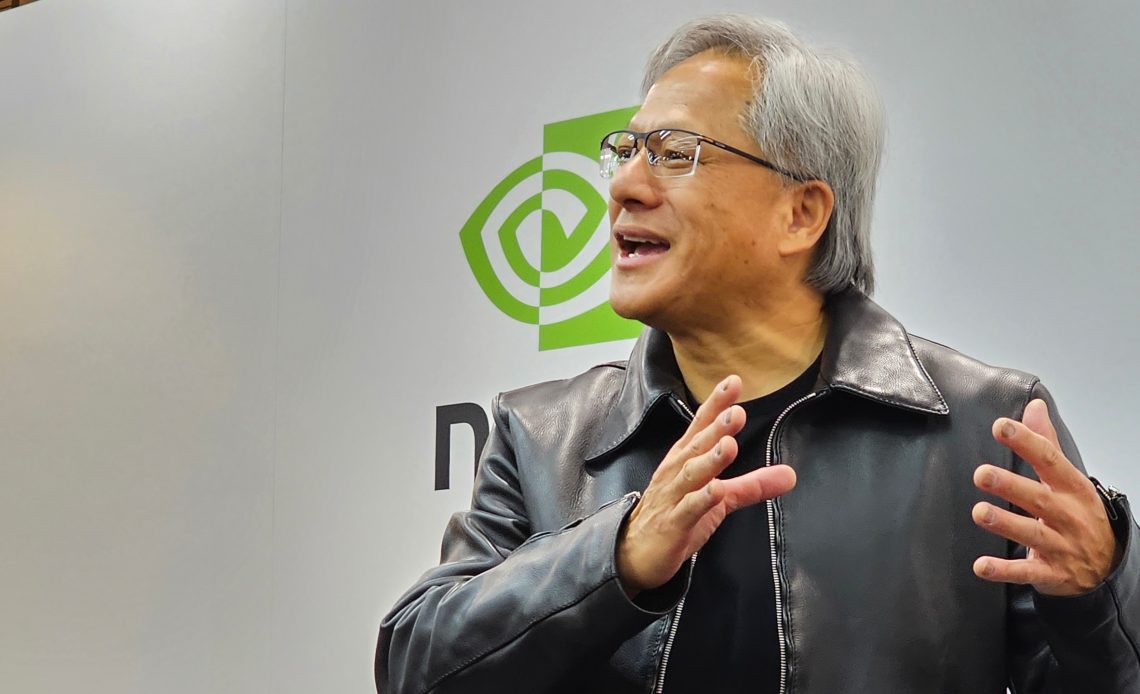
Storage is hard to find. Graphics cards are hard to find. RAM is extremely hard to find, even if you’re a PC manufacturing giant. And it’s all thanks to the “AI” data center buildout. But Nvidia, or at least its highly visible CEO Jensen Huang, couldn’t be happier about it.
“I love constraints,” said Huang at a recent conference. “In a world of constraints, you have no choice but to choose the best.”
Huang’s “no choice” means an inevitable buy from Nvidia, for GPUs that are crucial for said data centers. For context, Huang was asked about constraints on memory and electricity in the “token economy” at the Morgan Stanley Technology, Media & Telecom Conference, referring to “AI” output capability and not the more classical definition of the term.
Huang went on to say:
Huang continued, waxing on Nvidia’s ability to help data center builders optimize their rollout plans and resources. It’s the last part of this transcribed answer (emphasis added) that has raised eyebrows:
To be fair, the CEO is talking about much more specific topics than the RAM crunch that’s affecting the entire electronics industry, from the biggest PC manufacturers to cash-strapped home builders. But it’s hard to be even-handed when Nvidia is riding the “AI” bubble to become the largest and most powerful company on the planet.
PC Gamer notes in its report that Nvidia has a current evaluation of about $4.5 trillion dollars. Nvidia reported revenue of $130.5 billion in 2025, up over 100 percent on an already-strong 2024, with the lion’s share of that coming from data center customers.
If it seems like we’re not talking a lot about Nvidia’s graphics cards, the products the company is best known for by regular users around the world… well, yeah. At the Consumer Electronics Show, Nvidia had very little to say to consumers at all, shoving what little news it had that wasn’t about industrial applications into a secondary announcement—which didn’t include any new cards for the first time in years, instead focusing on DLSS improvements.
Nvidia is reportedly cutting down production on its RTX 5000 series, and may have cancelled a mid-cycle refresh of “Super” cards, all to more effectively focus on the enterprise market where it’s making bank. Even workstations, previously a tiny but profitable slice of the market, are getting more love than gaming PCs.
The really frustrating thing is that even if Nvidia seems to be ignoring gamers, gamers are still buying Nvidia cards. The company has a near-total stranglehold on the consumer graphics market, with a 94 percent share of desktops and laptops with discrete graphics cards going with Nvidia hardware. In the last year alone, the same report saw Nvidia’s main rival AMD slip from 15 percent down to 5 percent, with Intel holding onto a tiny sliver of just 1 percent.
As the future of consumer hardware seems to be in massive flux, if not actually in an existential crisis, Nvidia and Huang are going from strength to strength. If there was anyone in real life who’s swimming in gold coins in Scrooge McDuck style right now, it’d be Jensen Huang.
And if you’d like an “AI” to generate that image for you, then odds are pretty good it’ll be doing so with an Nvidia GPU.
Author: Michael Crider
Source: PCWorld
Reviewed By: Editorial Team