

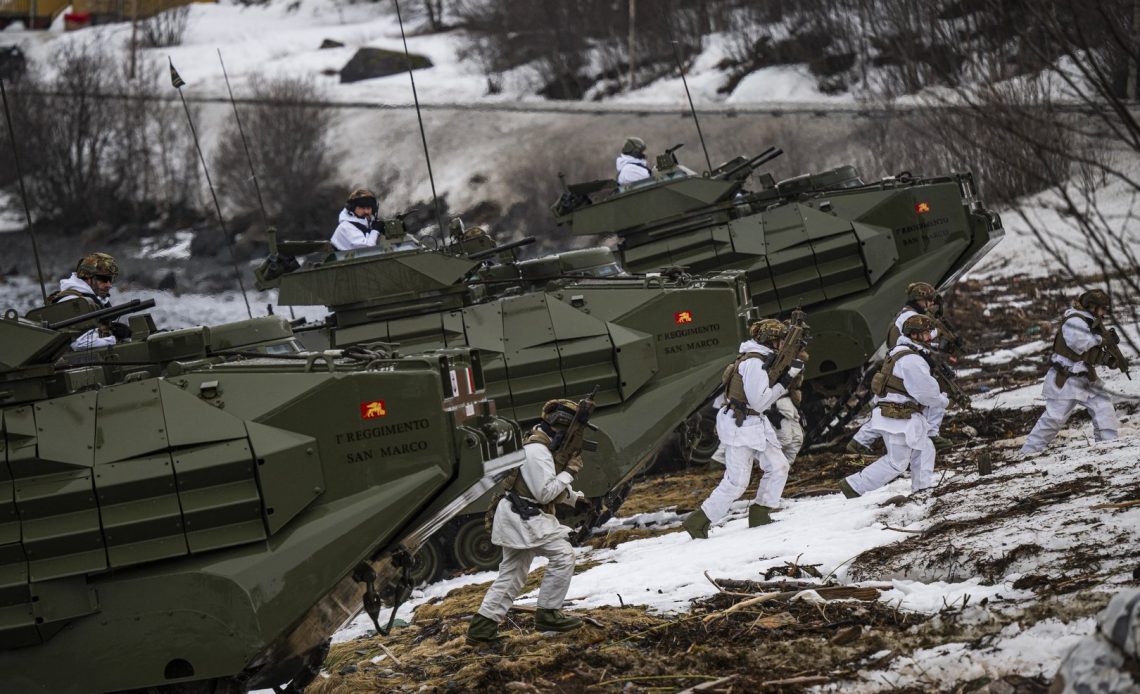
BRUSSELS — NATO nations are sending troops to Norway for a cold-weather exercise this week, as alliance officials kick off a yearslong analysis into causes for conflict in the Arctic.
As part of the planning effort, a U.S. and Norwegian-led research task force will compile a report by 2029 under the name “High North Scenarios for Wargaming and Analysis — Winter Storm 2030.”
Beyond the lead nations, NATO countries to have thus far committed to participating in the Arctic security simulation include Canada, the Czech Republic, France, Italy, Sweden and Turkey.
“The region faces rapid militarization of allied and threatening interests – NATO and nations are making procurement decisions that will field the force of 2030 and set the conditions for success and adaptation out to 2040,” a NATO technical activity proposal viewed by Defense News said.
Defense officials on both sides of the Atlantic have warned that the prospect of a war in the region is rising, with the expectation of Russia turning its attention to the region if and when the Ukraine conflict ends.
The High North has increasingly become a geopolitical hotspot, mainly due to the effects of climate change on melting sea ice, which has made the area more attractive and accessible for shipping and resource extraction.
NATO’s biennial Cold Response drill will take place from March 9-19 across Norway. It will include some 25,000 troops from 14 countries, including the U.S. and Denmark, and will feature naval, land, and air operations focused on Arctic defense.
The Pentagon is expected to have around 4,000 Marines participating in the drill, and thousands of Finnish and Swedish troops will also be partaking, operating out of Finland.
The exercise is part of Arctic Sentry, NATO’s ongoing mission to bolster its presence in the region, launched in February to ease tensions over Greenland.
In a report published last month, the D.C.-based Atlantic Council identified five Russian attack scenarios Europe must prepare for. Two of the five targets listed are located in the Arctic: the Svalbard archipelago and the Åland Islands.
In the first instance, the report states that Moscow may view greater value in exploiting the “territorial ambiguity” of the undefended archipelago, located 750 kilometers north of the Norwegian mainland.
It predicts that a variety of hybrid activities would precede any Russian attempt at capturing Svalbard, including the destruction of undersea critical infrastructure or placing intelligence officers in civilian clothes.
“Naval infantry from the Northern Fleet or airborne troops flown in from mainland Russia could rapidly seize and occupy the archipelago with little warning, presenting NATO with a fait accompli – it must prepare detailed plans to retake Svalbard in the event of aggression,” the document said.
One of the recommendations provided would entail the deployment of Norwegian special forces alongside U.S., UK, and Dutch marines who routinely train together in northern Norway and know the area well.
Author: Elisabeth Gosselin-Malo
Source: DefenseNews
Reviewed By: Editorial Team