

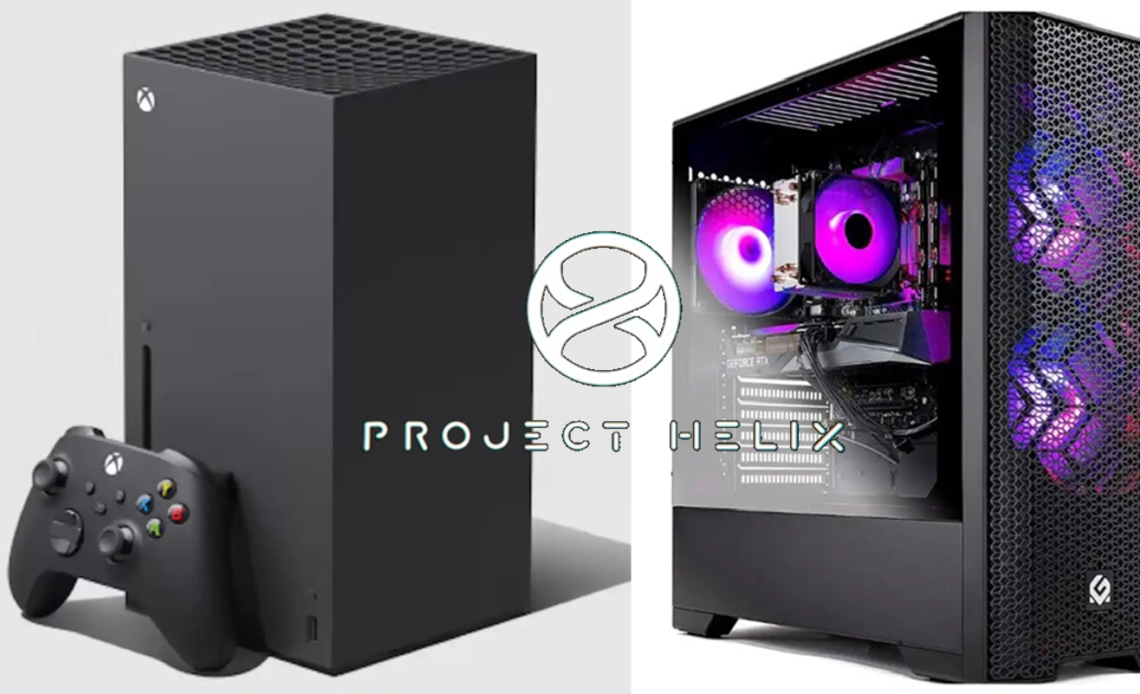
In summary:
- PCWorld reports that Microsoft’s next Xbox console, codenamed “Project Helix,” is expected to play both Xbox and PC games, further blurring platform boundaries.
- This convergence matters as it could redefine console gaming by leveraging AMD’s shared silicon architecture between Xbox and PC systems.
- The device aims to deliver leading performance while Microsoft’s “This is an Xbox” campaign suggests a unified gaming ecosystem across consoles and PCs.
Will the next Xbox be a PC? Maybe not, but at least it will be able to play “PC” games, the new head of Xbox said of “Project Helix,” the next iteration of the Xbox console series.
Asha Sharma, the newly appointed executive vice president and chief executive of Microsoft Gaming, disclosed Microsoft’s plans in a post on Twitter/X on Thursday.
“Great start to the morning with Team Xbox, where we talked about our commitment to the return of Xbox including Project Helix, the code name for our next-generation console,” Sharma wrote. “Project Helix will lead in performance and play your Xbox and PC games. Looking forward to chatting about this more with partners and studios at my first GDC next week!”
Sharma also disclosed a graphic describing Project Helix, which looked a little like an “X.”
The collision course between the PC and console continues
The intersection between the PC and the console has been a hot topic, especially as the line blurs. Last year, Windows Central predicted that the next Xbox would run the Xbox Full Screen Experience on top of Windows, or at least a version of it. The Full Screen Experience debuted as part of the Xbox Ally X, a handheld that the site had originally pegged as a full-fledged handheld Xbox, but ended up being very similar to other handheld PCs already in the market. The Full Screen Experience isn’t unique to the Xbox Ally X any more, either, but has been made available to other Windows handhelds, as well.
Back at the end of 2024, Microsoft began debuting a series of ads showing off various products, with the tag line “This is an Xbox.” (For some reason, Microsoft took down the page announcing this.) But over time, the Xbox and the PC have moved closer together: SOCs from AMD power the Xbox, while derivatives are at the heart of the PC. AMD, in fact, tipped the the Project Helix release this year. Games have been ported both to the PC and Xbox, of course, but certain Xbox games can use a mouse and keyboard, once the exclusive domain of the PC. And both the Xbox and the PC can use Microsoft’s Xbox Cloud Gaming feature, too — even with mouse and keyboard, too. Even the Xbox brand encompasses both the PC and the console.
(See more: Xbox vs gaming PCs: fight!)
The ability to “play Xbox and PC games” certainly allows for some wiggle room in the definition, then. Arguably, both devices already do. What remains to be seen is whether the same code will be shipped to both PCs and Project Helix consoles, or whether the console will continue to receive optimized versions of the game specifically written for the console.
In the real world, consoles differ from the PC in three main ways: the hardware, the interface, and the controller. The latter two go hand in hand — that’s why you see radial menus in console versions of Baldur’s Gate III, for example, but a more mouse-and-keyboard friendly user interface on the PC port. Mice and keyboards allow for games like real-time strategy games to be playable, but don’t really work on a couch. Microsoft will have to provide some way of solving this problem. Assuming that Microsoft ships a single version of Project Helix, AMD’s silicon will be a relatively simple problem to solve — the specs are what remain in question.
Microsoft’s big issue, then, is simply defining what a console is. Sony seems to believe in the traditional set-top box that has sat on your shelf for generations. Nintendo seems to be wandering away from that with its Switch, but it still can fit within a living-room dock. But Microsoft has always owned its own Xbox as well as the PC. Whether the two fuse together or remain somewhat separate remains to be seen.
When might we receive an answer? As early as next week, when Microsoft plans to talk about it during the Game Developers’ Conference in San Francisco.
Author: Mark Hachman
Source: PCWorld
Reviewed By: Editorial Team