

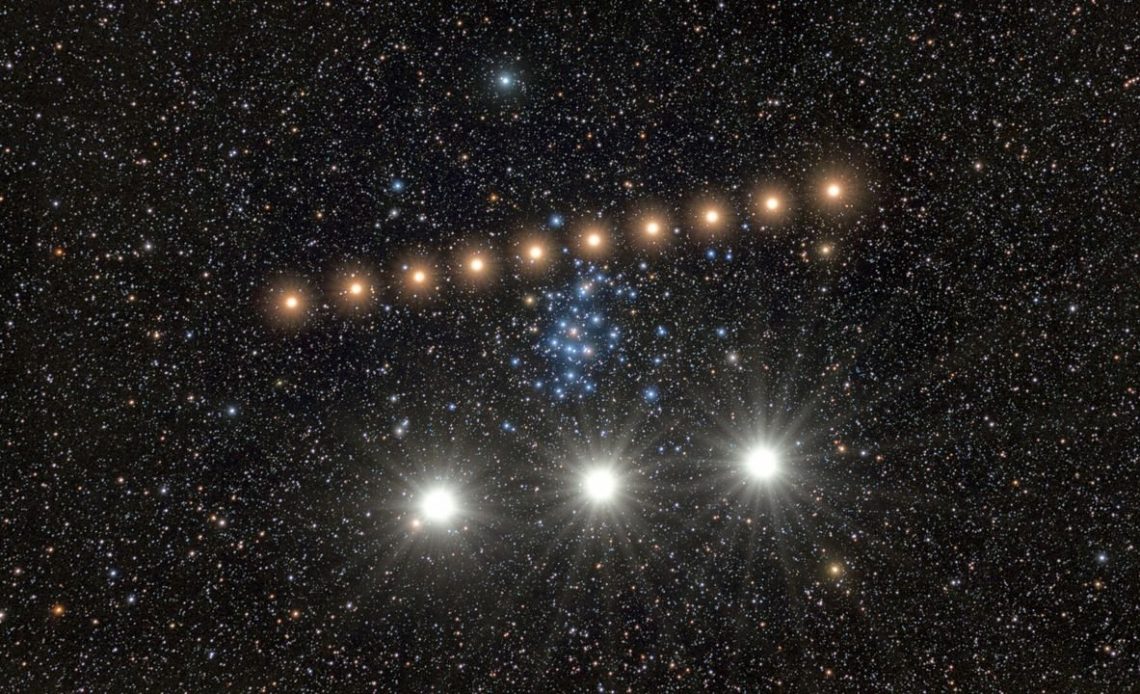
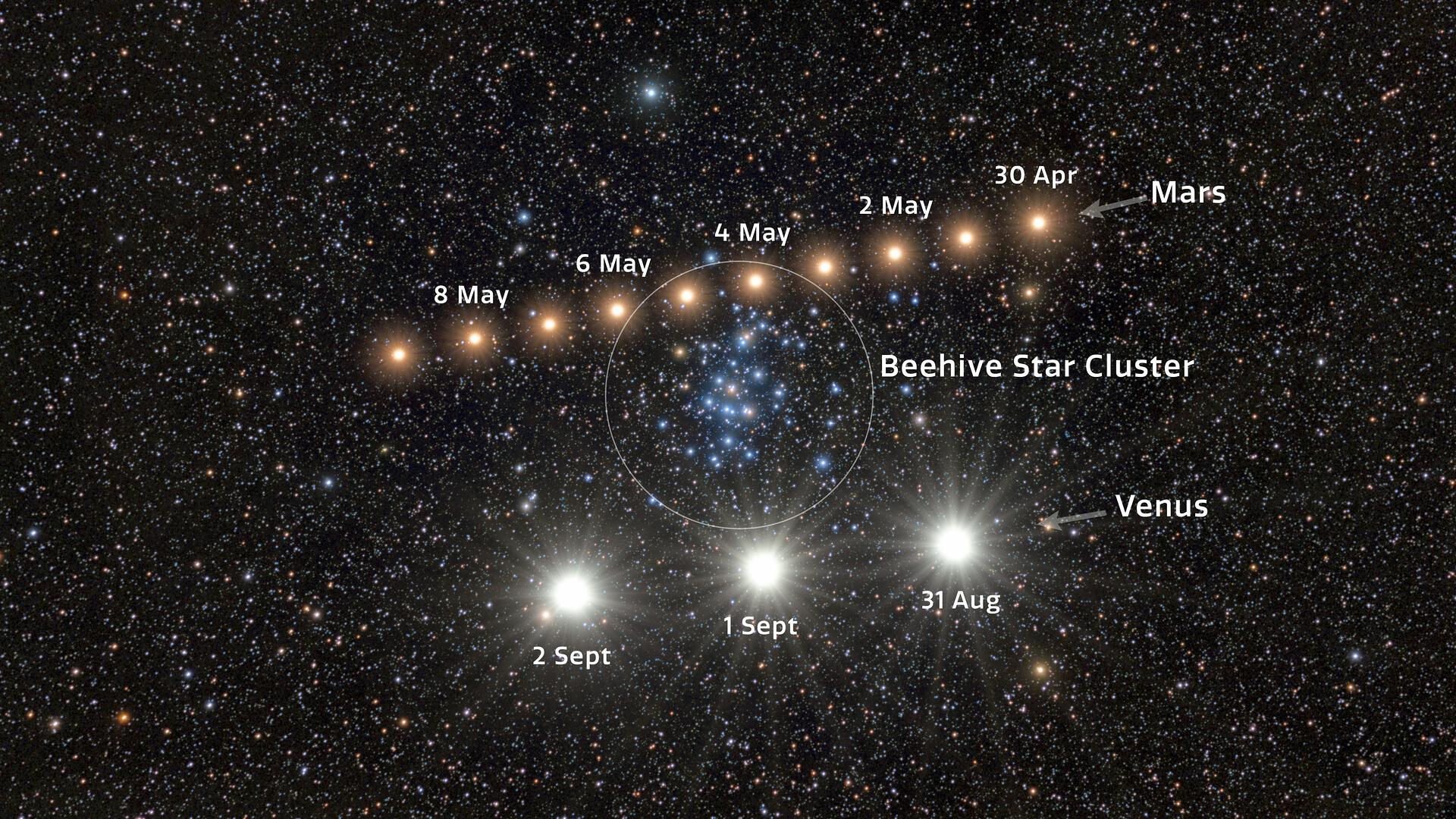
Skywatchers in the Southern Hemisphere were in for a rare treat as two planets formed a recent conjunction in the night sky. Mars (seen in the upper track) and Venus (lower track) appear to “cross” the open star cluster Messier 44 — better known as Praesepe or the Beehive Cluster— creating two bright, dotted paths against a dense swarm of starlight in this composite time-lapse photo. The image combines each planet’s nightly positions during separate 2025 apparitions, assembled by astrophotographer Petr Horálek, a NOIRLab Audiovisual Ambassador.
This composite image was weeks in the making, as Horálek’s two “crossings” happened months apart. Mars traced its path through the cluster from late April to early May 2025. Venus followed with a brief morning-twilight passage from late August to early September 2025, appearing low in early dawn light.
What is it?
The Beehive is a favorite skywatching target because it’s both nearby and rich: NASA describes M44 as an open cluster of around 1,000 stars at roughly 600 light-years away, in the constellation Cancer. In this image, the cluster is highlighted as one of the nearest and most star-packed open clusters visible from Earth, perfect for a “foreground vs. background” illusion when a bright planet happens to pass through the same line of sight.
Where is it?
These various time-lapse images were taken from sites in Chile, Bolivia, and the Czech Republic.
Why is it amazing?
People have long known that planets move relative to the stars — indeed, the word “planet” comes from the Greek term for “wanderer” — but it’s hard to internalize until you see a track like this: Night after night, the planets are somewhere new. The dotted paths turn an abstract fact — Earth’s viewpoint changing as planets move along their orbits — into something immediate and visual.
The Beehive cluster also sits close enough to the ecliptic (the plane of the solar system as projected on the sky) that planets can appear to pass through it. Seeing both Mars and Venus do so in the same year is a vivid reminder that the planets share a common orbital neighborhood, and that some deep-sky landmarks are perfectly placed for these striking conjunctions.
Want to learn more?
You can learn more about skywatching tips and star clusters.
Author: Kenna Hughes-Castleberry
Source: Space.com
Reviewed By: Editorial Team