

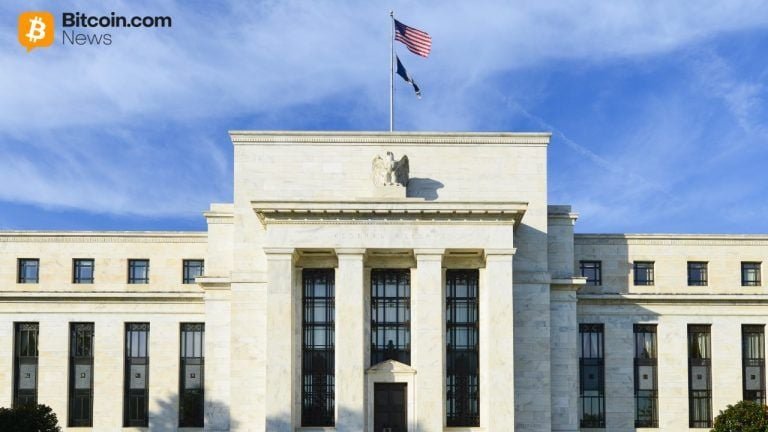
Mounting pressure on the Federal Reserve is reviving fears over U.S. monetary stability, pushing investors to reassess trust in central banking and accelerating capital flows toward bitcoin as a hedge beyond political control.
Central Bank Pressure Intensifies, Bitcoin Gains as Institutional Risk Hedge
A renewed debate over U.S. monetary stability is drawing investor attention. Devere Group, one of the world’s largest independent financial advisory organizations, released an opinion on Jan. 12, 2026, assessing whether mounting pressure on the Federal Reserve could set bitcoin up for a major price surge.
Chief executive officer Nigel Green stated:
“Markets recognize a deeper issue here than a policy disagreement. Pressure on the central bank of the world’s largest economy carries global consequences.”
“Confidence in monetary governance in the United States anchors financial stability far beyond its borders. When that confidence weakens, capital moves quickly toward assets designed to exist beyond political reach,” the executive added.
“Legal scrutiny of the chair of the most influential central bank on earth, set against sustained political demands on interest rates, sends a signal investors do not ignore,” he further shared, noting:
“ Bitcoin, typically, responds positively to precisely this kind of signal.”
Green pointed to recent market behavior in which equity futures softened, gold moved to record territory, the U.S. dollar weakened against major peers, and bitcoin advanced alongside those shifts, reflecting a reassessment of institutional trust rather than short-term policy outcomes.
At around 5:29 p.m., bitcoin is trading near $91,202 on Bitstamp, reflecting modest gains over the past day as price continues to churn within a tight intraday range. The session has seen bitcoin probe above $92,000 before slipping back toward the low $91,000 area, highlighting an indecisive tone as buyers and sellers battle for short-term control. Despite the choppy candles, price remains elevated compared to earlier consolidation near the $90,000 handle, suggesting the market is still digesting its most recent impulsive move rather than unwinding it completely.
Read more:
The Devere CEO explained that the Federal Reserve’s reach extends across global interest-rate cycles, capital flows, currency stability, and risk pricing, making its credibility central to worldwide financial confidence. “In past decades, political pressure on central banks drove flows almost exclusively into gold and defensive currencies,” he said. “Today, bitcoin absorbs part of that same demand.”
Green explained that institutional access through spot bitcoin exchange-traded funds (ETFs), regulated custody, and deeper derivatives markets has accelerated this transition. He observed: “Each episode highlighting tension between elected leaders and monetary authorities strengthens the case for assets governed by code rather than discretion. Bitcoin embodies that principle.”
He also remarked: “Some capital flows into gold, some into defensive currencies, and a growing share moves into bitcoin,” adding that emerging-market investors often seek protection from sovereign risk during periods of systemic uncertainty. “Investors in those regions often prefer assets beyond sovereign influence during periods of systemic uncertainty. Bitcoin fits that preference.” Green concluded:
“Financial history shows a consistent pattern. When political power edges closer to monetary control, investors seek distance from that power. In the modern era, many choose bitcoin. Currently rising prices reflect more than momentum.”
FAQ ⏰
- Why is the Federal Reserve pressure impacting bitcoin? Investors see political stress on the Federal Reserve as a signal to shift capital toward bitcoin as a hedge against monetary instability.
- What role does Devere Group play in the bitcoin outlook? Devere Group analysis highlights how weakening confidence in U.S. monetary governance can accelerate bitcoin demand.
- How are spot bitcoin ETFs influencing investor behavior? Spot have expanded institutional access, making it easier for large investors to allocate capital to .
- Why do emerging-market investors favor bitcoin during uncertainty? Emerging-market investors often turn to to reduce exposure to sovereign risk and political control.
Author: Kevin Helms
Source: Bitcoin
Reviewed By: Editorial Team