

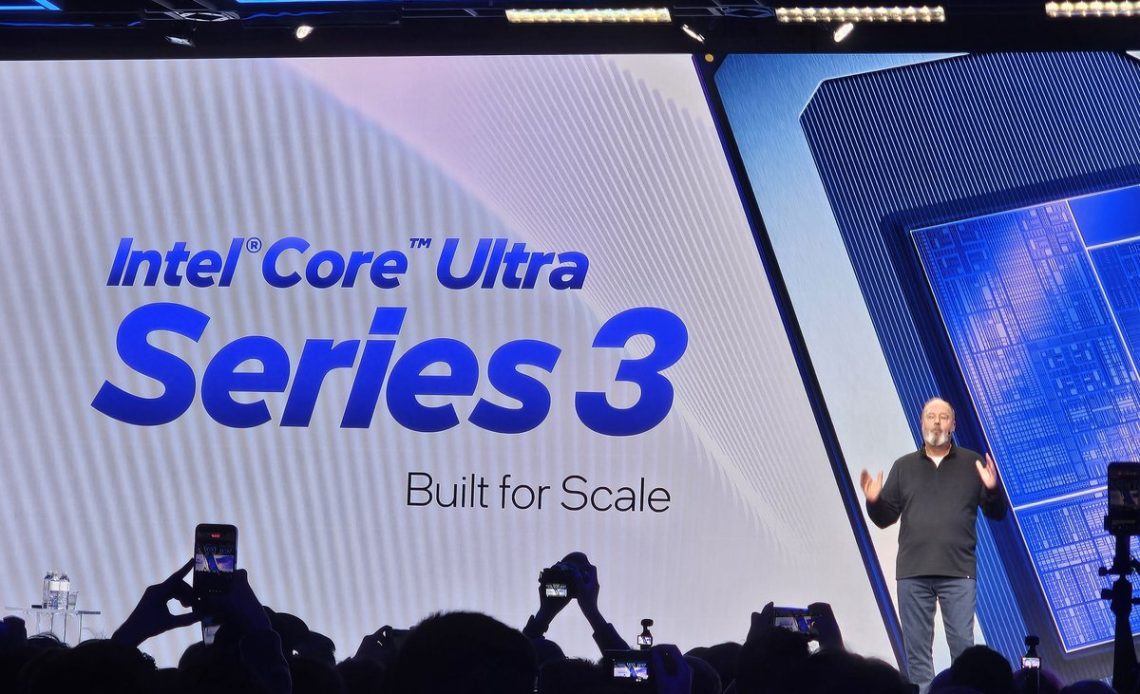
Intel’s Core Ultra Series 3 chips, aka “Panther Lake,” have entered the market, backed by dozens of PC makers.
“We’ve beeen out there shaping what it means for fundamental computing, said Jim Johnson, senior vice president and general manager of the Intel Client Computing Group, in a launch event at CES 2026.
Lip-Bu Tan, Intel’s chief executive, said he was “proud” to highlight that Intel has shipped its first Intel 18A processors, the production technology upon which Panther Lake is built upon. The technology uses RibbonFET gate-all-around to manage current and energy efficiency, while PowerVia is Intel’s name for backside power delivery, enabling 15 percent better performance per watt.
Intel showed off what was simply known as “Panther Lake” in October, when Intel announced the Panther Lake technology along with some of its implementations.
Intel’s Core Ultra Series 3 chips return to the era of performance cores (P-cores), efficiency cores (E-cores,) and low-power efficiency cores (LP E-cores) of Intel’s Core Ultra 100 chip, aka Meteor Lake. Those are paired with an NPU capable of 50 TOPS worth of AI processing as well as Intel’s Xe3 GPU, which should improve Intel’s 3D capabilities.
Intel said then that Panther Lake’s single-threaded performance should be 10 percent higher than Lunar Lake at the same power. Compared to both Lunar Lake and Meteor Lake, Intel’s Panther Lake offers more than 50 percent better multithreaded performance, Intel said in October. But the power should be 10 percent less than Lunar Lake.
Anecdotally, Intel representatives have been characterizing Panther Lake as the performance of Arrow Lake — an architecture which struggled on the desktop but performed surprisingly well in Arrow Lake laptops — with the power consumption of Lunar Lake.
Panther Lake consists of three different organizations of the P-cores, E-cores, and LP-cores:
At CES 2026, Johnson said that the Panther Lake delivers about 60 percent more power than the Core Ultra 200 series, or Lunar Lake, using the Cinebench 2024 mujlticore benchmark. Depending upon the banchmark, Intel cut the power by about 2.8X.
Somewhat like AMD’s Ryzen AI Max (“Strix Halo”) or the Ryzen 9000X3D family, both of which concentrate large amounts of cache memory to improve performance, it’s the final “12Xe” configuration that will form the premium lineup on many laptops. The GPU will be called the Intel Arc B390 graphics, said Intel’s Dan Rogers, the vice president in charge of PC products at Intel. On average, gaming performance will be about 73 percent more than Lunar Lake, Rogers said.
The B390 GPU can also take advantage of frame generation to improve frame rates further, he said. XeSS3 can render three AI-generated frames for every GPU-rendered frame, Rogers said.
How good does Intel think Panther Lake is? Intel will launch an entire handheld platform, based on Panther Lake, later this year, Rogers said, taking on AMD’s leadership in the space, Rogers said.
Intel’s partners have over 200 Core Ultra Series 3 designs on tap, Johnson said.
“There’s a Series 3 solution for everyone,” Johnson said.
Updated at 5:10 PM with additional detail.
Author: Mark Hachman
Source: PCWorld
Reviewed By: Editorial Team