


U.S. markets slid sharply on Monday as President Donald Trump’s new 15% global tariff and intensifying artificial intelligence (AI) disruption fears rattled investors, dragging down stocks and crypto while gold and silver climbed on safe-haven demand.
AI Disruption and Trade Tensions Roil Markets
Wall Street opened the week in retreat. The Dow Jones Industrial Average fell , or roughly 735 points, to close near 48,890. The S&P 500 declined to about 6,835, and the Nasdaq Composite dropped to roughly 22,618.
The trigger was policy — again. Just days after the Supreme Court most of Trump’s prior tariffs on Feb. 20, the president invoked Section 122 authority over the weekend, raising a new global tariff from 10% to 15%, effective Feb. 24. Investors dislike uncertainty, and sudden trade escalation tends to amplify it.
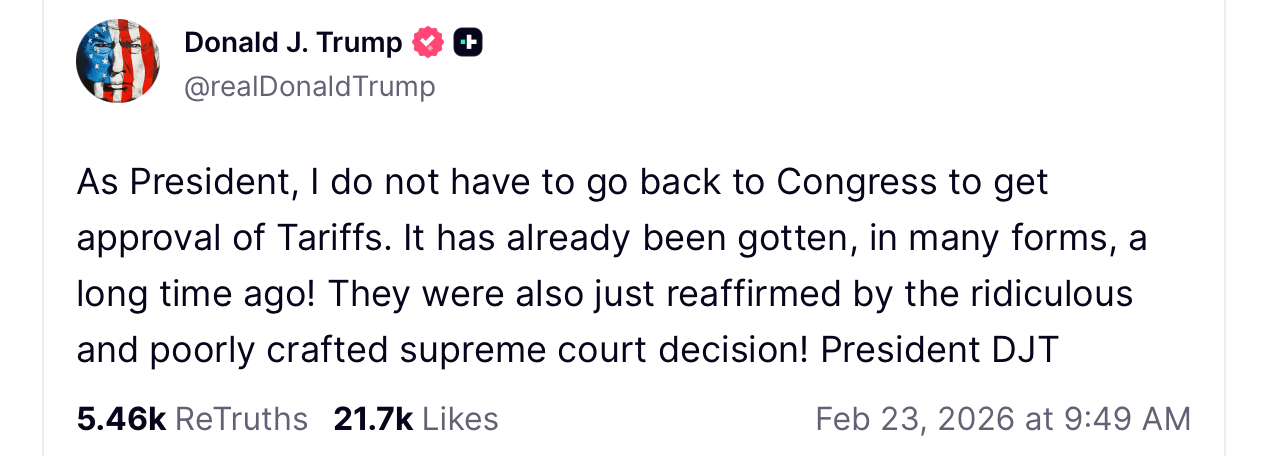
Higher tariffs can increase input costs for companies, compress profit margins, and invite retaliation from trading partners overseas. Even if the broader economy shows no immediate recession signals, markets price forward risk. Monday’s session reflected that repricing in real time.
At the same time, the trade — once the darling of the rally — showed signs of strain. Software and legacy technology names faced renewed scrutiny as investors reassessed how generative AI could disrupt established revenue streams.
One of the day’s most notable casualties was IBM, which closed at , down 13.14%. The sell-off an announcement from Anthropic that its Claude Code system can automate COBOL modernization.
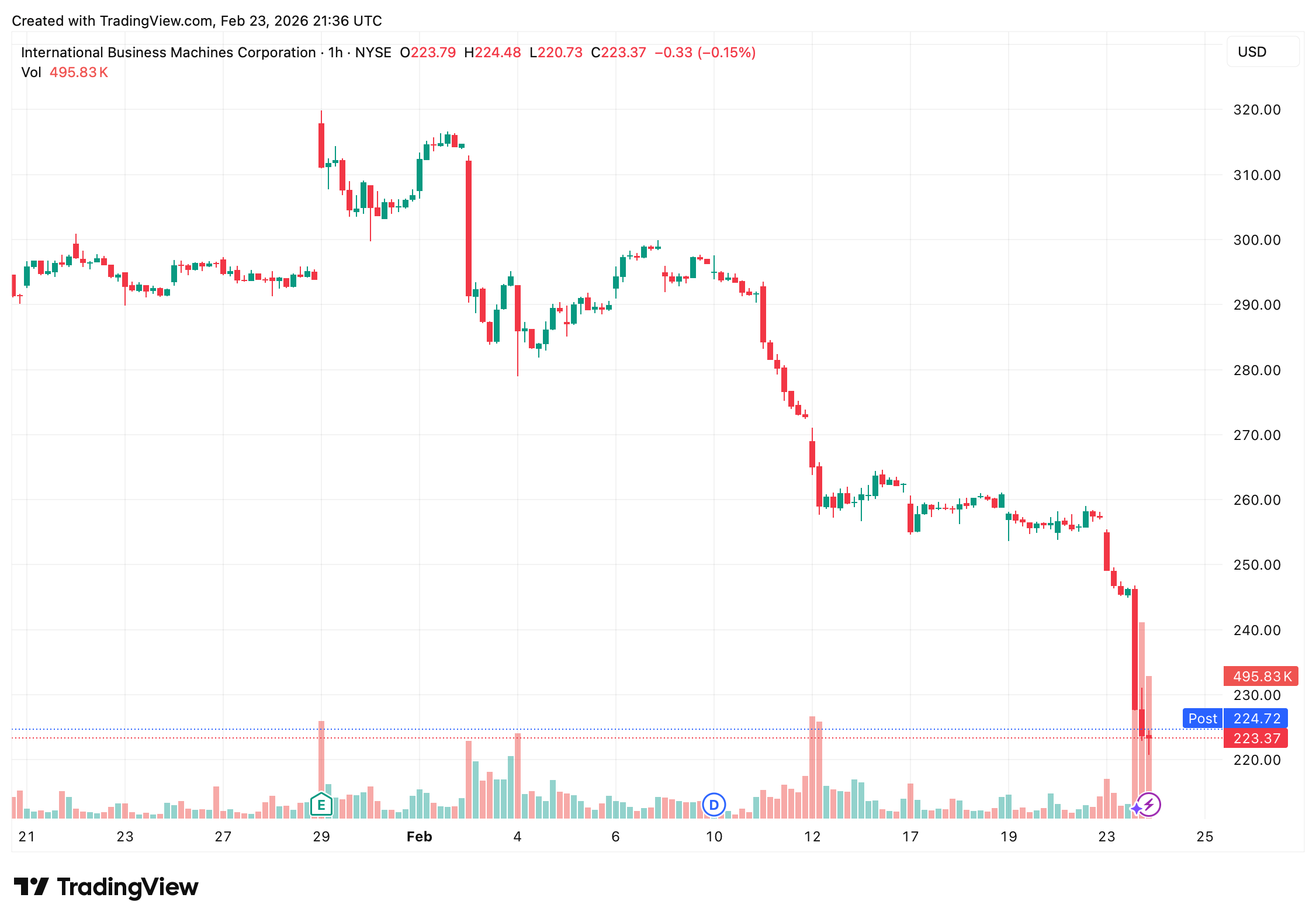
COBOL may sound like a relic, but it powers vast portions of the financial system, including the majority of U.S. ATM transactions and many government platforms. Modernizing those systems has been a lucrative business for IBM’s mainframe and consulting units. If AI can perform that work faster and at lower cost, investors see long-term revenue pressure.
IBM is now down roughly 26% for the month, pretty much pointing to how quickly AI enthusiasm can morph into competitive anxiety. Cryptocurrencies tracked the risk-off tone. Bitcoin tumbled to a low of on Bitstamp, down more than 4% on the day, as investors pulled back from higher- volatility assets. Ether dropped as much as 5.2% intraday, and the broader digital-asset market followed equities lower.
The move reinforced bitcoin’s behavior during macro stress events: when tariffs rise, and global trade uncertainty increases, capital often rotates out of crypto assets like bitcoin first. Some analysts argue the sell-off could prove temporary if no further policy shocks materialize, but trade tensions remain a key overhang.
“We are set to close six straight weeks of weekly red candles on bitcoin for the first time since May 2022,” , VP of growth at , Pro Trader, and host of Trading Spaces, told Bitcoin.com News on Monday. “Similar to equities, bitcoin has had a sharp pullback today, driven largely by renewed tariff-related uncertainty, similar to the events of April 2025.”
The Kraken executive added:
“Furthermore, ratcheting geopolitical tensions could likely prove bearish for BTC in the short-term. The $60k level is a key support level that the bulls are watching closely. If that level fails to hold, we could potentially see a move into the mid-to-low $50K range.”
While stocks and crypto struggled, precious metals . Gold futures climbed about 1.96% to $5,209 per ounce, extending a powerful multi-month run. Silver outperformed, rising 7.65% to $88.64 per ounce.
Safe-haven demand played a central role. When geopolitical friction and economic uncertainty increase — including ongoing — investors frequently seek assets perceived as stores of value. Silver’s industrial demand component adds momentum when investors anticipate continued infrastructure and technology investment, giving it additional lift relative to gold.
Gold has gained more than 74% over the past year, outpacing many equity benchmarks. Monday’s rally suggested that, at least for now, investors are still hedging policy and geopolitical risk with hard assets rather than high-growth equities.
In sum, Monday’s trading sessions across markets delivered a clear message about the current psychology. Who moved markets? , via tariff escalation, and AI developers and innovations challenging legacy business models. What happened? Stocks and crypto fell, IBM plunged, and precious metals advanced. Where did it unfold? Across U.S. exchanges and global digital-asset markets. Why did it happen? Because trade policy shifts and technological disruption alter earnings expectations and risk tolerance almost instantly.
The coming days will test whether Monday was a sharp adjustment or the start of a broader repricing. Investors will watch for responses from major trading partners, additional White House commentary and incoming economic data. For now, markets appear to be recalibrating — and doing so decisively.
FAQ 🔎
- Why did U.S. stocks fall on Feb. 23, 2026? Stocks declined after President Trump raised global tariffs to 15%, increasing uncertainty around trade and corporate earnings.
- Why did IBM drop more than 13%? IBM fell after Anthropic introduced an AI tool capable of automating COBOL modernization, threatening a key revenue stream.
- Why did bitcoin move lower with equities? declined amid a broader risk-off shift as investors reduced exposure to assets during tariff escalation.
- Why did gold and silver rise? Precious metals gained as investors sought safe-haven assets amid trade tensions and geopolitical uncertainty.
Author: Jamie Redman
Source: Bitcoin
Reviewed By: Editorial Team