

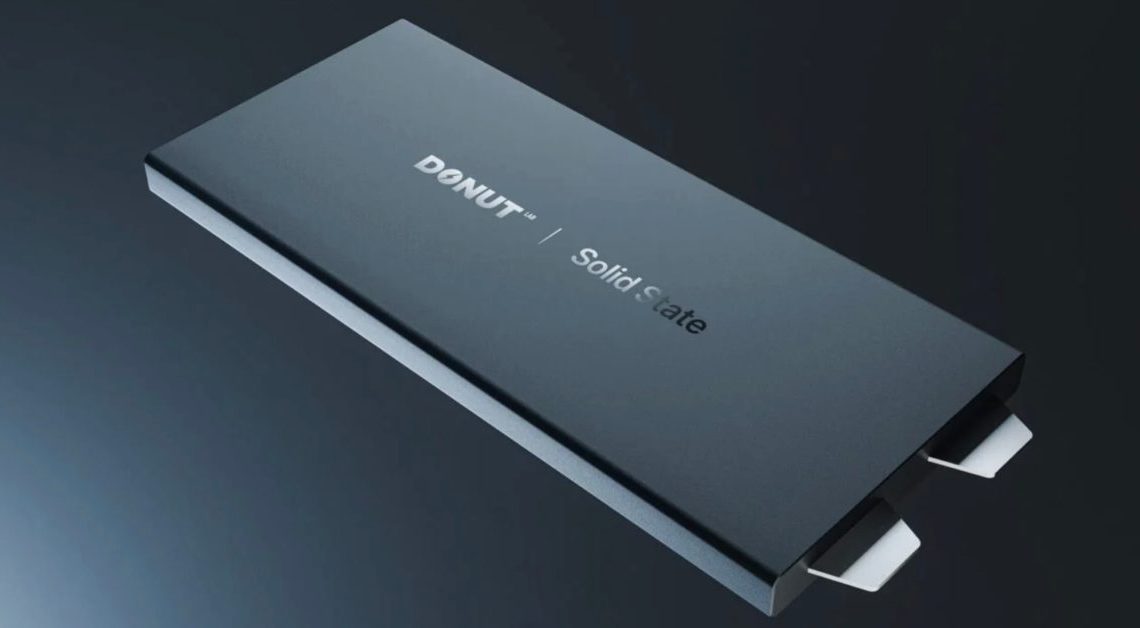
Donut Lab has released the first independent test results for its controversial solid-state battery, and the data confirms at least one headline claim: the cell charged from 0 to 80% in just 4.5 minutes at an extreme 11C rate.
It doesn’t blow up, but it gets pretty damn hot.
The results come from Finland’s state-owned VTT Technical Research Centre, one of Europe’s leading research organizations. But the report only covers charging performance — leaving Donut Lab’s most extraordinary claims completely unverified.
The VTT test results
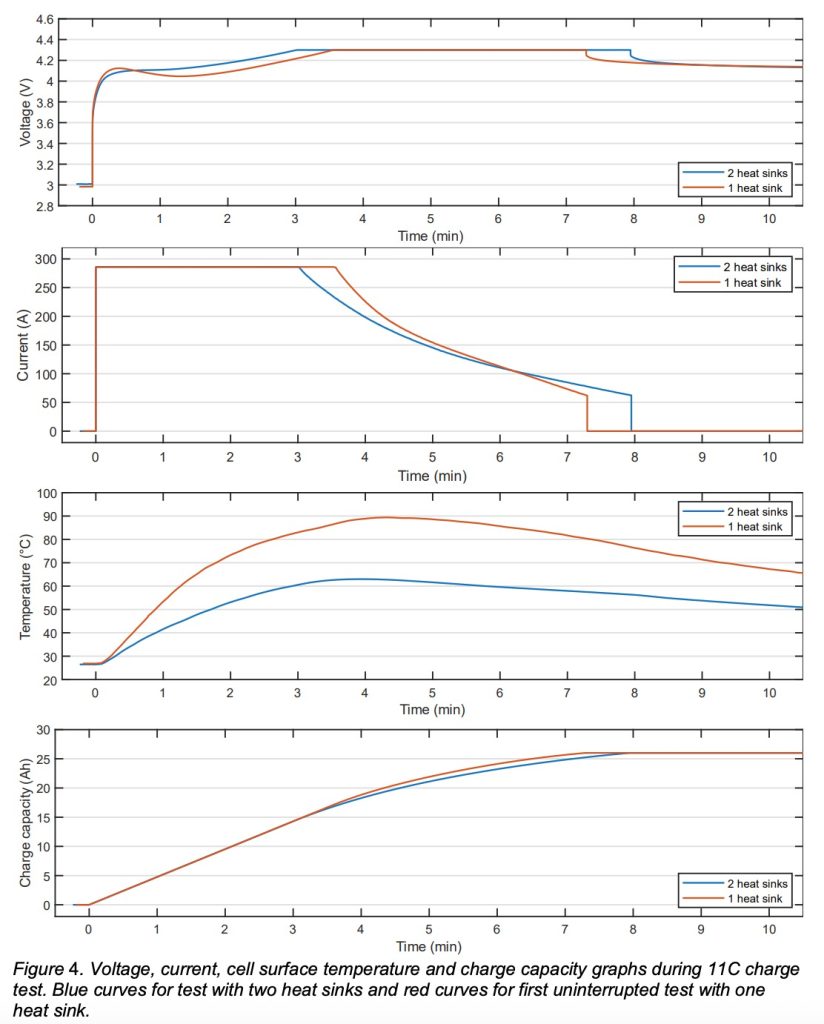
The VTT report (VTT-CR-00092-26) tested a single 26 Ah Donut Lab cell using a PEC ACT0550 battery tester in a climate-controlled chamber. The cell was charged at two rates: 5C (130A) and 11C (286A), using a constant-current/constant-voltage protocol up to 4.3V. Before and after each charge, the cell was discharged at 1C down to 2.7V to verify full capacity was available.
The charging speed results are legitimately impressive.
At 11C with two heat sinks, the cell reached 80% state of charge in 4.5 minutes, with the surface temperature climbing from 26.5°C to a peak of 63°C. At 5C with a single heat sink, the cell charged fully with temperatures rising from 27°C to 61.5°C. At 5C with two heat sinks, the peak temperature was only 47°C from a starting point of 23.4°C.
But here’s where it gets interesting. During the 11C test with only a single heat sink, the configuration closest to minimal thermal management, the cell’s surface temperature hit the 90°C safety cutoff, forcing VTT to interrupt the test. After a four-minute cooling period, the cell was strapped more tightly to the heat sink to improve thermal contact, and the test was restarted.
That 90°C incident matters. Donut Lab has marketed this battery as needing no active cooling, but at 11C charge rates, even passive thermal management with a single heat sink proved insufficient. In a real vehicle, consistent 11C charging will require some thermal engineering, not a deal-breaker, but a gap between the marketing and the measured reality.
What the report does NOT cover
This is where the “catch” comes in. The VTT report addresses one claim and one claim only: fast charging. The specifications that drew the harshest industry criticism remain completely untested by any independent party:
400 Wh/kg energy density — This is the claim that Svolt’s chairman called physically impossible. For context, Factorial Energy’s solid-state cells validated by Stellantis achieved 375 Wh/kg, and FAW’s semi-solid-state cells claim over 500 Wh/kg — but neither of those also claims 11C charging and 100,000 cycles simultaneously. The combination of all three is what experts say defies known battery chemistry.
100,000 cycle life — Most solid-state developers target hundreds to low-thousands of cycles at this stage. Factorial’s validated cells showed over 600 cycles. Donut Lab’s claim of 100,000 is orders of magnitude beyond anything demonstrated in the industry. It’s arguably the biggest claim.
Extreme temperature performance — Donut Lab claimed 99% capacity retention at -30°C and stable performance above 100°C. Not tested.
Cost parity with lithium-ion — Not something a lab test can verify, but a claim that strains credibility given that no solid-state battery has reached cost competitiveness at scale.
The skepticism timeline
The context for these results is important. When Donut Lab unveiled this battery at CES in January, the company provided no live demonstrations, no patent disclosures, and no peer-reviewed research. Svolt Energy’s chairman Yang Hongxin called it a “scam,” stating that “all the parameters are contradictory” and that “any technician with basic knowledge would recognize it.”
Donut Lab CEO Marko Lehtimäki fired back, telling Electrek that he was betting his personal reputation on the technology shipping in customer Verge Motorcycles within weeks. The company then commissioned VTT, a credible, state-backed institution, to independently verify its claims.
The results are being published through a dedicated website called “I Donut Believe” and a video series that launched today.
How it compares to the competition
The broader solid-state battery landscape provides useful context. BYD hit a solid-state milestone and targets small-batch production by 2027. CATL has a similar timeline. Toyota is targeting mass production by 2030. Geely plans its first solid-state pack this year.
None of these established players claim to have a production-ready cell today with all of Donut Lab’s specifications simultaneously. That’s either because the Finnish startup has genuinely leapfrogged the entire industry, or because its full set of claims won’t hold up under comprehensive testing. This first VTT report doesn’t resolve that question.
Author: Fred Lambert
Source: Electrek
Reviewed By: Editorial Team