

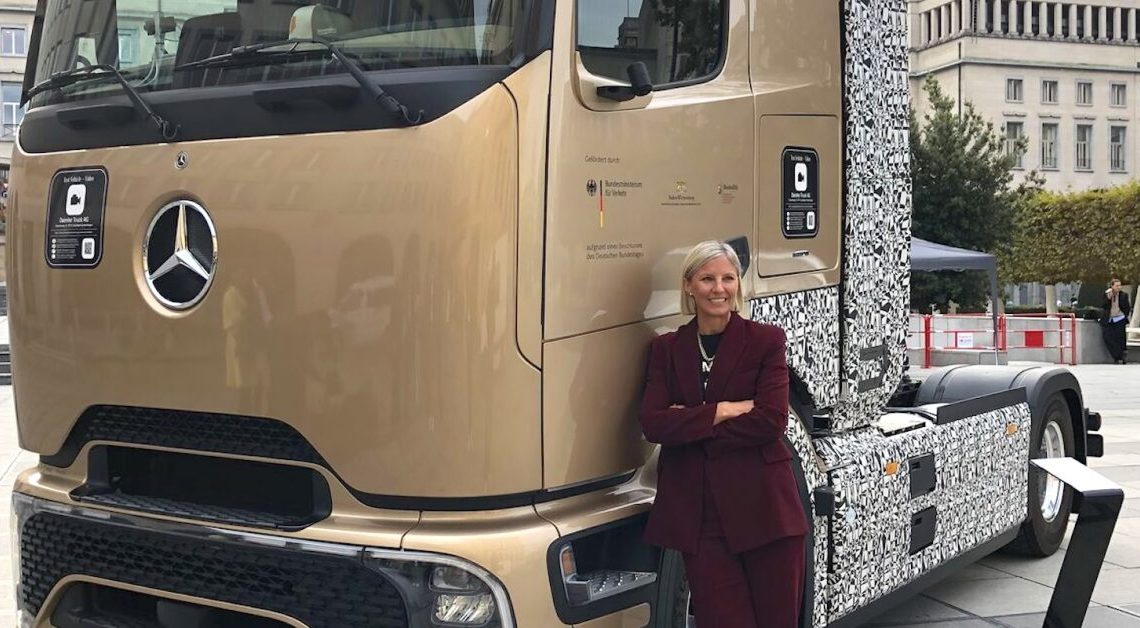
Daimler Truck AG CEO Karin Rådström hopped on LinkedIn today and dropped some absolutely wild pro-hydrogen talking points, using words like “emotional” and “inspiring” while making some pretty heady claims about the viability and economics of hydrogen. The rant is doubly embarrassing for another reason: the company’s hydrogen trucks are more than 100 million miles behind Volvo’s electric semis.
UPDATE 14MAR26: tiny Workhorse pulls 20 MILLION miles ahead of mighty Daimler.
Whenever I hear about a small last‑mile delivery fleet hitting a major milestone, I can’t resist poking fun at Daimler Truck’s CEO for bragging last September about their hydrogen trucks crossing a “miles driven” mark that wouldn’t be impressive for a single Honda Civic. As such, I found this week’s news that tiny Workhorse Group has logged more than twenty MILLION all‑electric miles (to say nothing of Volvo’s 100+ million-mile electric fleet) to Daimler’s maybe 200,000-ish hydrogen miles to be especially hilarious.
You can check out that original article, below, then let us know what you think of Daimler’s hydrogen future in the comments.
30SEP2025
Earlier this month, Daimler Truck AG issued a press release entitled, “Five and a Half Times Around the World: Daimler Truck Fuel Cell Trucks Successfully Complete More Than 225,000 km (~139,000 miles) in Real-World Customer Operations.” Don’t bother looking for it on Electrek, though. I didn’t run it. And I didn’t run it because, frankly, a fleet of over-the-road semi trucks managing to cover a little over half the number of miles that David Blenkle put on his single Ford Mustang Mach-E isn’t particularly impressive.
In the meantime, Daimler competitors like Volvo, Renault, and even tiny Motiv are racking up millions and millions of all-electric miles and MAN Truck CEO Alexander Vlaskamp is saying that it’s impossible for hydrogen to compete with batteries. Heck, even Daimler’s own eActros BEV semi trucks are putting up better numbers than those hydrogen deals.
So, why then is Rådström pouring on the hydrogen love over at LinkedIn?
For some reason – posts about hydrogen always stir up emotions. I think hydrogen (not “instead of” but “in parallel to” electric) plays a role in the decarbonization of heavy duty transport in Europe for three reasons:
- If we would go “electric only” we need to get the electric grid to a level where we can build enough charging stations for the 6 million trucks in Europe. It will take many years and be incredibly expensive. A hydrogen infrastructure in parallel will be less expensive and you don’t need a grid connection to build it, putting 2000 H2 stations in Europe is relatively easy.
- Europe will rely on import of energy, and it could be transported into Europe from North Africa and Middle East as liquid hydrogen. Better to use that directly as fuel than to make electricity out of it.
- Some use cases of our customers are better suited for fuel cells than electric trucks – the fuel cell truck will allow higher payload and longer ranges.
At European Hydrogen Week, I saw firsthand the energy and ambition behind Europe’s net-zero goals. It’s inspiring—but also a wake-up call. We’re not moving fast enough.
What we need:
- Large-scale hydrogen production and transport to Europe
- A robust refueling network that goes beyond AFIR
- And real political support to make it happen – we need smart, efficient regulation that clears the path instead of adding hurdles.
To show what’s possible, we brought our Mercedes-Benz GenH2 to Brussels. From the end of 2026, we’ll deploy a small series of 100 fuel cell trucks to customers.
Let’s build the infrastructure, the momentum, and the partnerships to make zero-emission transport a reality. 🚛 and let’s try to avoid some of the mistakes that we see now while scaling up electric. And let’s stop the debate about “either or”. We need both.
KARIN RÅDSTRÖM
Commenters were quick to point out that Daimler recently received €226M in grants from German federal and state governments to build 100 fuel cell trucks – but, while Daimler for sure doesn’t want to give back the money, it’s also pretty difficult to believe that Rådström’s pro-hydrogen posturing is sincere.
Especially since most of it seems like nonsense.
We’re not doing any of that

At the risk of sounding “emotional,” Rådström’s claims that building a hydrogen infrastructure in parallel will be less expensive than building an electrical infrastructure, and that “you don’t need a grid connection to build it,” are objectively false.
Further, if her claim that “putting 2,000 H2 stations in Europe is relatively easy” isn’t outright laughable, it’s worth noting that Europe had just 265 hydrogen filling stations in operation in 2024 (and only 40% of those, or about 100, were capable of serving HD trucks). At the same time, the IEA reported that there are nearly five million public charging ports already in service on the continent.
Next, the claim that, “Europe will rely on import of energy, and it could be transported into Europe from North Africa and Middle East as liquid hydrogen” (emphasis mine), is similarly dubious – especially when faced with the fact that, in 2023, wind and solar already supplied about 27–30% of EU electricity.
I will agree, however, with one of Rådström’s claims. She notes that, “some use cases of our customers are better suited for fuel cells than electric trucks – the fuel cell truck will allow higher payload and longer ranges.” That’s debatable, but widely accepted as true … for now. Daimler’s own research into lighter, more energy-dense, and lower-cost solid-state battery technology, however, may mean that it won’t be true for long, however.
Unless, of course, Mercedes’ solid-state batteries don’t work (and she would know more about that than I would, as a mere blogger).
Author: Jo Borrás
Source: Electrek
Reviewed By: Editorial Team