

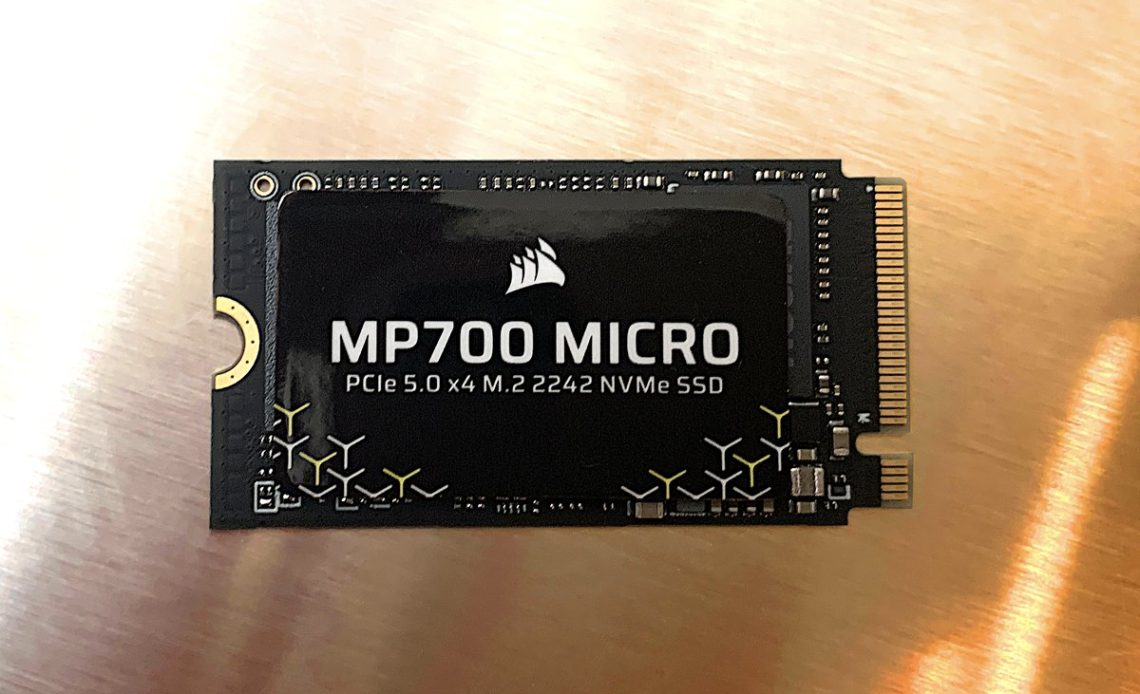
There are a few devices out there (Lenovo/HP laptops, Nvidia DGX Spark) that sport smaller 2242 (42mm long) PCIe 5.0 M.2 slots. If you have one, then the new Corsair MP700 Micro, successor to the MP600, can leverage much of the extra bandwidth.
I say much of, because the MP700 Micro’s sequential benchmark numbers are about 60 percent of what you’ll see from full 2280 PCIe 5.0 NVMe SSDs. That said, it’s certainly faster than any short PCIe 4.0 SSD I’ve tested — by a lot.
Read on to learn more, then see our roundup of the best SSDs for comparison.
The MP700 Micro uses Phison’s E31T host memory buffer (HMB) controller to harness four lanes of PCIe 5.0, delivering data to and from its 218-layer TLC (Triple-Level Cell/3-bit) NAND.
Corsair warranties the MP700 Micro for five years, or 600TBW (terabytes that may be written) — whichever arrives first. Unless you’re extraordinarily active writing data, that should be the former easily.
The MP700 Micro comes in 2TB/$250 and 4TB/ $485 capacities (though, as of this writing only the 4TB option is available). That’s not bargain bin, but also not absurdly out-of-line pricing. You do pay a bit extra for the form factor, but less is more, as they say. (Yes, I know…)
There’s good news and bad news concerning the MP700 Micro’s performance. It’s far faster than 2230/2242 PCIe 4.0 NVMe SSDs. But it’s also considerably slower in some ways than a full 2280 PCIe 5.0 SSD.
As this is our first small-fry PCIe 5.0 SSD, we have no other results for the class. Instead, we’ve compared our 4TB MP700 Micro test unit to it’s top-of-the-line 2280 cousin — the MP700 Pro XT (2TB) — and the PCIe 4.0 drive the MP700 Micro is replacing — the MP600 Micro (1TB).
In CrystalDiskMark 8’s sequential throughput tests, the difference between the three drives is blatantly obvious.
When it came to CrystalDiskMark 8’s 4K file tests, however, the competition was much closer. The increased throughput of PCIe 5.0 over 4.0 doesn’t make nearly as much of a difference with small files. What is a bit surprising is that the MP700 Pro XT, which is a DRAM design, didn’t skewer the other two drives.
When it came to real-world 48GB transfers, the MP700 Micro held its own under Windows Explorer. But with Fast Copy, the greater potential of the MP700 Pro XT is apparent, as is the slower throughput of the MP600 Micro.
As for the longer 450GB write, the MP700 Micro held its own against the MP700 Pro XT, but at least partly because it’s a 4TB unit and the Pro XT is only 2TB.
Writing 450GB to the MP700 Micro revealed some speed fluctuations, with it dropping to around 1GBps to 1.5GBps near the end. I can live with that.
If you have the PCIe 5.0 port to support it, then the MP700 Micro offers both greater capacity, and good performance. It’s a worthy upgrade if your unit doesn’t already sport a PCIe 5.0 SSD.
Absolutely. Buy the MP700 Micro if you have a small 2242 PCIe 5.0 M.2 slot that you need to fill. But don’t buy it because you think it’ll look cute in a slot that accepts larger 2280 SSDs. The latter will give you better sustained throughput. Much better if you leverage Fast Copy.
Drive tests currently utilize Windows 11 24H2, 64-bit running off of a PCIe 4.0 Samsung 990 Pro in an Asus Z890-Creator WiFi (PCIe 4.0/5.0) motherboard. The CPU is a Core Ultra i5 225 feeding/fed by two Crucial 64GB DDR5 5600MHz modules (128GB of memory total).
Both 20Gbps USB and Thunderbolt 5 are integrated into the motherboard and Intel CPU/GPU graphics are used. Internal PCIe 5.0 SSDs involved in testing are mounted in an Asus Hyper M.2 x16 Gen5 adapter card sitting in a PCIe 5.0 slot.
We run the CrystalDiskMark 8.04 (and 9), AS SSD 2, and ATTO 4 synthetic benchmarks (to keep article length down, we report only the former) to find the storage device’s potential performance. Then we run a series of 48GB transfer and 450GB write tests using Windows Explorer drag and drop to show what users will see during routine copy operations, as well as the far faster FastCopy run as administrator to show what’s possible.
A 25GBps two-SSD RAID 0 array on the aforementioned Asus Hyper M.2 x16 Gen5 is used as the second drive in our transfer tests. Formerly the 48GB tests were done with a RAM disk serving that purpose.
Each test is performed on a NTFS-formatted and newly TRIM’d drive so the results are optimal. Note that in normal use, as a drive fills up, performance may decrease due to less NAND for secondary caching, as well as other factors. This issue has abated somewhat with the current crop of SSDs utilizing more mature controllers and far faster, late-generation NAND.
Note that our testing MO evolves and these results may not match those from previous articles. Only comparisons inside the article are 100% valid as those results are gathered using the current hardware and MO.
Author: Jon Jacobi
Source: PCWorld
Reviewed By: Editorial Team