

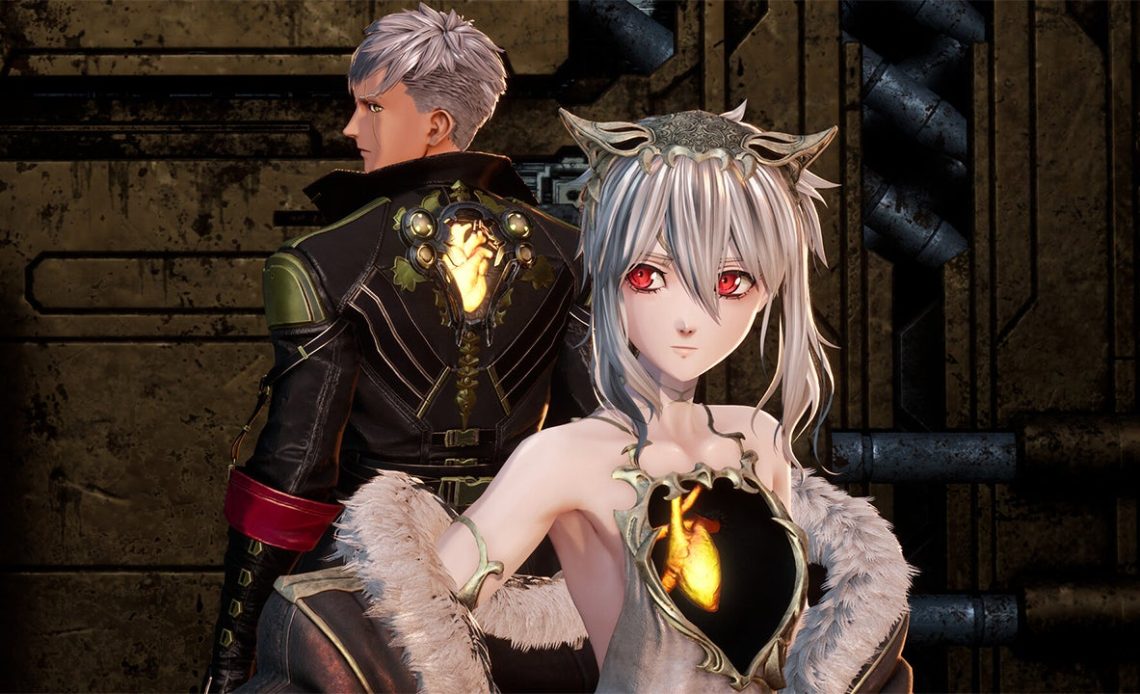
“Anime Souls” is a term often used to describe the original Code Vein. And while that is a very simple but fair descriptor – it is after all one of the very few soulslike games with an undeniably anime aesthetic – it also doesn’t really describe what was actually cool about the 2019 action RPG. For instance: the emotional storylines of your companion characters, delivered in these excellent sequences where you relive their most tragic memories; the phenomenal score by the wonderful Go Shiina; the flexible Blood Code system that allowed players to switch up their stats and playstyle without having to respect their whole character while also being able to pick and choose skills from other “classes.” There was certainly room for improvement in the core combat and level design, but it had great ideas, and would benefit from some refinement and iteration.
And that’s what Code Vein 2 seems to be all about: Refinement and iteration. Based on the three or so hours that I’ve played, Code Vein 2 felt familiar, but altogether much more confident and focused on the strengths of the original, while also getting off to an immediately more interesting start thanks to a brand new story with some intriguing time travel twists.
Like the first game, at the heart of Code Vein 2’s plot is a catastrophe that occurred many, many years ago. This time around, it’s known as the Resurgence, a calamity that corrupted everything it touched and gave rise to a new being known as a Revenant. Somehow, the Revenants managed to seal the Resurgence, but the victory was short-lived, as soon after, the Resurgence… well, surged again. This led to a battle that became known as the Upheaval, in which several heroes gave their lives to seal the Resurgence once again. One hundred years later, that seal is weakening, causing existence-erasing explosions all over the world, and this time, the means to save everything exists not in the present, but in the past.
And thus the stage is set for Code Vein 2’s time-hopping story that sees the nameless protagonist teaming up with Lou Magmell, a Revenant with the power to jump back and forth through time as they link up with the heroes of the past to try and find a way to stop the imminent world-ending threats of the future.
It’s a pretty good hook! As someone who never really got invested in the world of Code Vein 1, outside of learning more about my companions, I was pretty happy that I was immediately invested this time around. I looked forward to seeing how the heroes of the past fought back against the Resurgence and what ultimately brought about their fates. I got a chance to ask Code Vein 2’s director, Hiroshi Yoshimura, if he looked to any specific sources of inspiration with regards to their interpretation of time travel, or the rules that govern it, and he said, “I wouldn’t say there’s one film or work in particular, but one golden rule that we had within the development was that once the player has observed or seen something happen within the game, then that becomes truth, or that becomes locked in the sense that it can’t be overturned.”
Thicker Than Blood
On the gameplay side of things, much of the core of Code Vein 1 is still intact in the sequel. It’s still a stamina-governed combat system with a big focus on special abilities tied to various Blood Codes, which essentially determine your class or playstyle. Switching to a new Blood Code changes your stats, defense, and your max Ichor, which is essentially the mana that powers your special abilities. One of the interesting new twists of Blood Codes is that they also now come with a series of traits that can dramatically affect how you approach combat. For example, traditionally, the way combat works is you attack an enemy to inflict stacks of bleed, and then use a special technique known as a jail attack (previously known as “Drain Attacks”) to collect that blood, which then gets converted into the Ichor that you use to use your special skills.
But if that doesn’t sound like your style of play, you could instead use Josée’s Blood Code, which lets you gain Ichor simply by attacking, but that boon comes with a catch. If you gain more than your maximum Ichor, you take a significant chunk of damage. This was my preferred method of play, as it meant that I didn’t have to fish for opportunities to use my jail attacks to regain my Ichor, and it helped me be extra vigilant about using my abilities regularly so I didn’t end up overflowing with Ichor. Of course, my attention would occasionally wane, and this would occasionally be the death of me, but regardless, I appreciated the added twist to the gameplay.
In fact, pretty much every aspect of Code Vein 2’s combat is more customizable than before. While Drain Attacks used to be tied to your Blood Codes, they’re now got their own equippable slot in your inventory, and there are a ton of different types. You’ve got the returning Ogre claw for a fast and short ranged option; Hounds for a powerful two-hitting mid-range attack; Stinger to nail enemies from afar; and then you’ve got a handful of completely new attacks like Ivy, which caused spikes to emerge from the ground and can be placed by charging the attack and moving the targeting circle; Bat, which causes you to grow wings and sends out a swarm of bats, and Reaper, which is a scythe that can be swung around to hit enemies in an AOE.
In addition to Jails, you can also equip powerful subweapons known as Bequeathed Formae, and you can also choose a Defensive Formae as well.. With regards to the Bequeathed Formae, I only got to see two of these in my demo: a Battle Axe known as Idris’s Conceit, and a Longbow called Statesman’s Longbow. I opted more for a strength build throughout most of my demo time, so I primarily used the Battle Axe, and it certainly was a difference- maker in fights where I would get swarmed by enemies. All I needed to do was create some space to account for the lengthy windup, and boom. Once it hit, it would create a temporal field that slowed everything down, making it easy to clean up the survivors.
As for the Defensive Formae, you’re able to basically choose whether you want a standard block, a parry, or a dodge, with a couple of others thrown in there with some slight differences in how they perform. Im a huge fan of all these changes, as they allow even finer tuning of a build to your personal preference without becoming too overwhelming or complicated.
The Big Question
One of the most common things that always gets discussed anytime there’s a new soulslike in town is how difficult it is, so let’s talk about it. For the most part, I got through this demo without much issue. Granted, this was a provided save, so it’s hard to say how things would have been if I got to this point on my own playthrough with my own loadout, but Bandai Namco was very generous in giving us a wide selection of weapons, Blood Codes, and jails, and I never felt like I was particularly under- or overlevelled.
Code Vein 2 also smartly lets you decide on whether you want your companion to follow you and participate in combat like an AI coop partner, or whether you’d prefer to have them be assimilated into you, providing you with specific buffs, but without giving you the benefit of another body to deal damage or distract enemies. It’s a great trade-off that allows Code Vein 2 to maintain the companion element that makes it such a distinct soulslike in the first place, while also allowing players who enjoy tackling these challenges as a solo player to do so without feeling like they’re being severely punished.
Where the difficulty really turned up several notches was in the two boss battles that I got to experience. These were true tests of skills and reflexes and took nearly half of my allotted three hours of playtime, and that’s without even delivering the final blow against the second one. The first boss could simply wipe out my health with just one or two hits, while also afflicting me with the acid status effect, which would deal damage over time. My windows to punish were very small, making me opt for a strength-oriented build so I could land a powerful and chargeable overhead slash with my greatsword to make the most out of those opportunities. Eventually, I prevailed, only to be hard stuck against the second boss. This boss was fast, had an extremely dangerous second phase that I didn’t get to see enough of to really learn its new attacks, and had the nasty habit of electrifying the floor and inflicting bind on me, which would paralyze me long enough for the boss to land another free attack.
Despite the difficulty spike, I loved both these encounters, and while I’m a bit salty that I couldn’t finish the job at the preview event, I’m looking forward to the runback once I get the full game in my hands and can attempt the boss with my own personal build. Overall, Code Vein 2 is shaping up to be a marked improvement over the original in just about every area. We’ll see if Bandai Namco is able to stick the landing when this soulslike sequel releases on January 30, 2026 for PlayStation 5, Xbox Series X|S, and PC.
Author: Mitchell Saltzman
Source: IGN Gaming
Reviewed By: Editorial Team