

Most wildlife photographers dream of capturing lions stalking prey on the African savanna. One 17-year-old found his apex predator much closer to home… but needed a microscope-level view to see it.
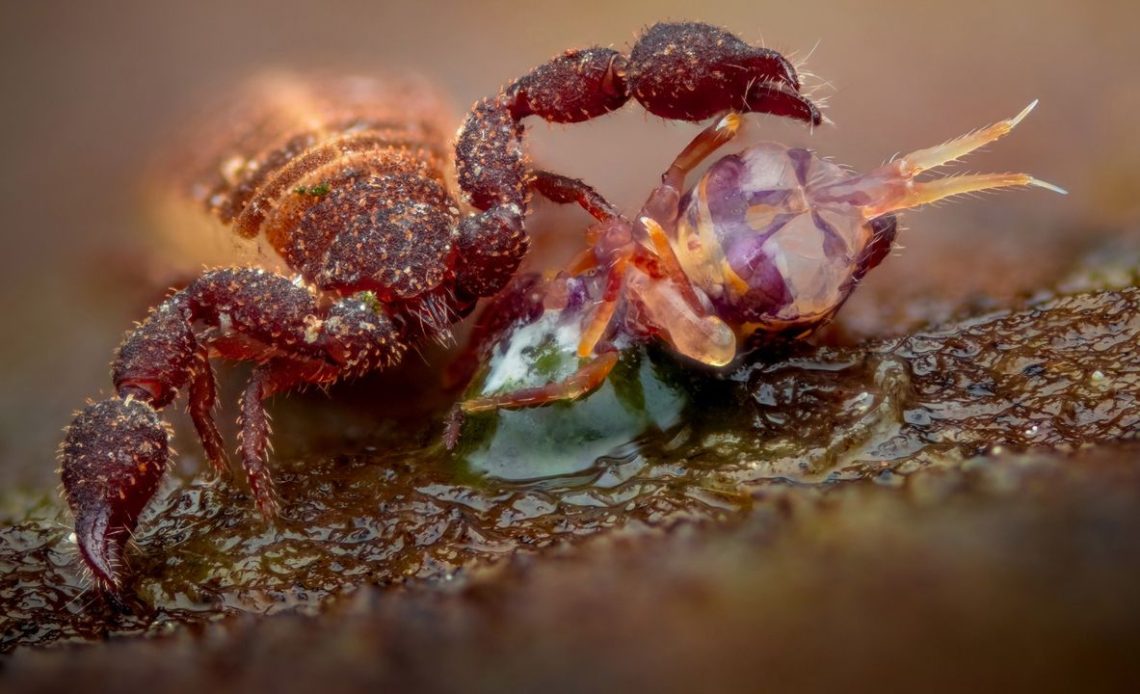
Predator is an extraordinarily detailed image of a pseudoscorpion (chernes cimicoides) preying upon a springtail. It won the German photographer Alexis Tinker-Tsavalas the Youth 15-17 years category at the GDT European Wildlife Photographer of the Year 2025, and rightly so.
Pseudoscorpions, despite their fierce look in this image, measure only a few millimeters long. Capturing this moment of predation required significant patience, fieldcraft and the technical ability to execute a complex imaging technique. That a teenager managed all three speaks volumes about his dedication and skill.
Technical challenge
During an photo excursion in early spring, Tinker-Tsavalas encountered the pseudoscorpion and immediately saw his opportunity. The youngster deployed a Fujifilm X-H2 paired with a Laowa 25mm f/5.6 2.5-5x Ultra Macro lens.
The X-H2’s 40MP X-Trans sensor proved ideal for this demanding work. At this resolution, the X-H2 provides the pixel density necessary to capture minuscule details when working at extreme magnifications.

The Laowa glass was also crucial. While most macro lenses stop at 1:1 (life-size), this specialist lens extends from 2.5x to 5x magnification, revealing details invisible to the naked eye. This extreme magnification, coupled with the lens’s specialized design that minimizes distortion, ensures the quality needed across the numerous frames required for the focus stack.
Tinker-Tsavalas took the shot at ISO 320 with flash and diffuser. The process was meticulous, requiring shooting 104 separate exposures at varying focal planes. These frames were later combined through focus stacking software. This allowed him to render both the pseudoscorpion and its prey in sharp focus throughout; an impossible feat with conventional photography at this magnification, where depth of field is measured in fractions of a millimeter.
Focus stacking at ultra-macro magnifications, though, is challenging. Maintaining consistent lighting across all 104 exposures is critical, as any microscopic movement between frames can misalign the final stack. Tinker-Tsavalas’s use of flash with a diffuser ensured even, controlled illumination, while the short flash duration helped freeze any movement from the active subject.
Artistic achievement
Beyond the technical prowess, the image also demonstrates a mature approach to composition. The low shooting angle emphasizes the pseudoscorpion’s aggressive, predatory posture, while the resulting background is rendered soft and unobtrusive. The controlled lighting expertly reveals the rough texture of the arachnid’s exoskeleton and the delicate, transparent form of its prey.
Overall, this image highlights macro photography’s unique ability to reveal a hidden world: dramas that unfold constantly beneath our feet, invisible without the specialized tools and the artistic vision to capture them.
It also stands as a reminder that extraordinary wildlife photography is accessible and doesn’t always require exotic destinations. Sometimes it just requires looking closer at what’s already there.
Author: Tom May
Source: DigitalCameraWorld
Reviewed By: Editorial Team